
Americans Shop for Bar Stools. Most of Them Need Counter Stools.
Search data shows the words people use and the height they actually need have come apart. We pulled the numbers.
Search for stools in the United States and one phrase dominates: bar stools, at roughly 90,500 searches a month. Counter stools trails at 27,100.
That ratio suggests bar height is what most people want. The rest of the data says the opposite.
The numbers
When shoppers specify a height rather than using the generic term, the picture inverts:
| Search term | Monthly volume |
|---|---|
| Counter height stools | 22,200 |
| Bar height stools | 8,100 |
Counter height outsearches bar height by 2.7 to 1.
The same pattern holds when shoppers search by measurement, even while still using the word bar:
| Search term | Monthly volume | Actual height class |
|---|---|---|
| 24 inch bar stools | 2,400 | Counter |
| 30 inch bar stools | 1,600 | Bar |
A 24-inch seat is a counter stool. It is being searched for under the phrase bar stools more often than the genuinely bar-height option.
The single clearest signal
Look at the questions people ask alongside bar stools. The highest-volume one, at roughly 1,000 searches a month, is:
How tall are counter height bar stools?
That phrase contains both terms at once. It is not a typo or an edge case. It is the most-asked question in the category, and it is a shopper trying to reconcile a word they have always used with a measurement they have just discovered matters.
Sorting every height question asked under bar stools by which height it actually specifies produces a near-even split:
| Intent behind the question | Combined monthly volume |
|---|---|
| Counter height | ~2,320 |
| Bar height | ~2,160 |
Roughly half the people asking about bar stool height are describing a counter.
Why this happens
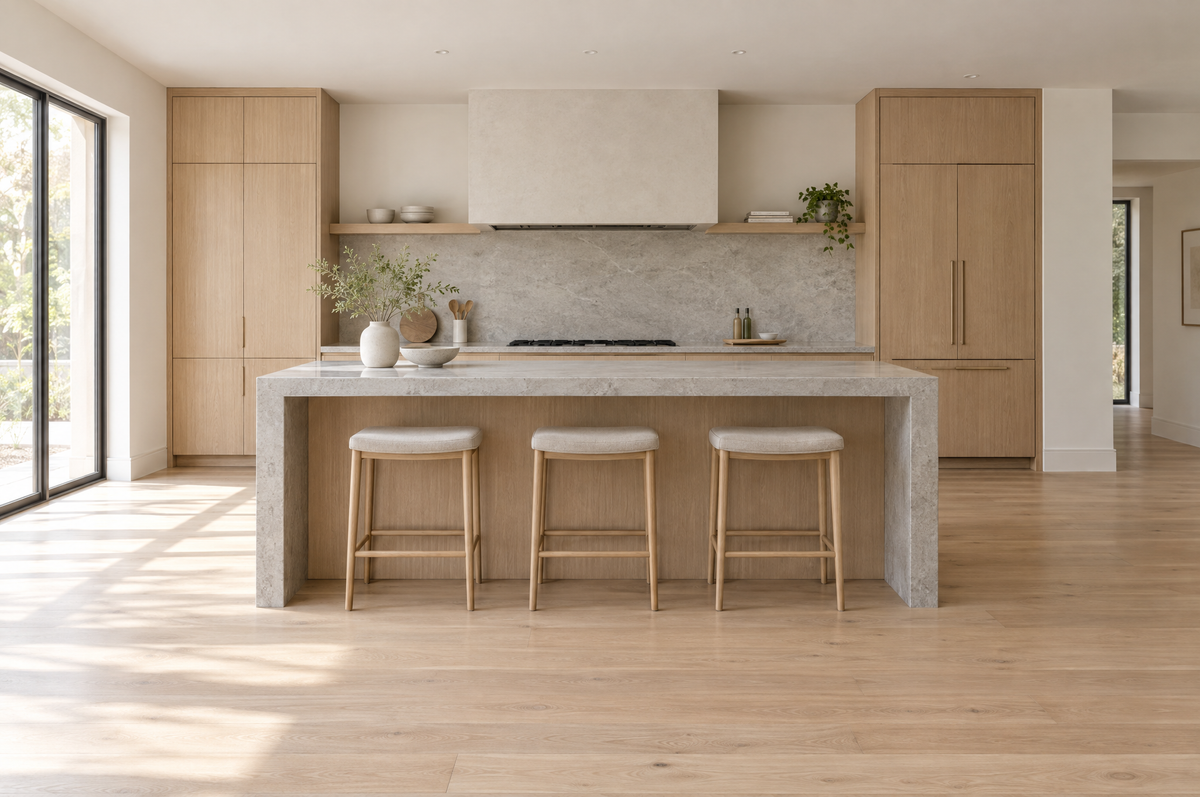
American kitchens standardized on a 36-inch counter. Kitchen islands, peninsulas and breakfast bars in most homes built or renovated in the last thirty years sit at that height.
A 36-inch surface takes a 24 to 26 inch seat. That is a counter stool.
A 29 to 31 inch seat, the true bar stool, is built for a 40 to 42 inch surface. That height belongs to a commercial bar, a home bar built as a raised second tier, or an older kitchen with a genuine raised bar counter.
The vocabulary is older than the fixture. Bar stool became the general word for a tall kitchen seat before most kitchens had islands at all, and it stuck after the underlying furniture changed. The word describes a place. The measurement describes a fit. They stopped agreeing.
What the mismatch costs
Seat height is not a preference. It is a fit.
The working rule is 10 to 12 inches of clearance between the seat and the underside of the surface. A 30-inch stool at a 36-inch counter leaves 6 inches, so knees hit the counter and there is nowhere to put your legs. A 24-inch stool at a 42-inch bar leaves 18 inches, so the surface sits at chest height.
Neither is a matter of taste. Both are returns.
How to actually choose
Measure the surface from the floor to the underside of the countertop, not to the top of it. Overhang thickness varies and the underside is what your knees meet.
| Surface height | Seat height you need | What it is called |
|---|---|---|
| 36 inches | 24 to 26 inches | Counter stool |
| 40 to 42 inches | 29 to 31 inches | Bar stool |
| 28 to 30 inches | 17 to 19 inches | Dining chair |
If your kitchen island is a standard 36 inches, you need counter stools, whatever the product listing calls them. For a raised bar at 40 to 42 inches, bar stools are the right class.
A worked example: the rattan counter stools have a 26 inch seat. At a 36 inch counter that leaves 10 inches of clearance, at the bottom of the comfortable range. At a 42 inch bar the same stool would leave 16 inches, which is too low to use.
Adjustable-height stools exist and cover both ranges, but they introduce a gas cylinder and a swivel mechanism, which are the two parts most likely to fail. For a fixed surface at a known height, a fixed stool is usually the better buy.
Frequently asked questions
How tall are counter height bar stools?
Counter height stools have a seat 24 to 26 inches from the floor. They are built for a 36 inch counter, which is the standard height of kitchen islands and peninsulas in most American homes. This is the most-asked question in the category, at roughly 1,000 searches a month, and the phrase itself mixes both terms.
What height stool do I need for a 36 inch counter?
A 36 inch counter takes a 24 to 26 inch seat, which is a counter stool. Measure from the floor to the underside of the countertop rather than the top of it, because overhang thickness varies and the underside is what your knees meet.
What is the difference between a bar stool and a counter stool?
The difference is seat height. A counter stool has a 24 to 26 inch seat for a 36 inch counter. A bar stool has a 29 to 31 inch seat for a 40 to 42 inch bar. Bar stool is often used as a general word for any tall kitchen seat, which is why the two get confused.
How much clearance should there be between a stool and the counter?
Allow 10 to 12 inches between the seat and the underside of the surface. A 30 inch stool at a 36 inch counter leaves only 6 inches, so knees hit the counter. A 24 inch stool at a 42 inch bar leaves 18 inches, so the surface sits at chest height.
Are 24 inch stools bar height or counter height?
A 24 inch seat is counter height, despite being widely sold and searched as a 24 inch bar stool. It suits a 36 inch counter. True bar height starts at 29 inches.
Should I buy adjustable height stools?
Adjustable stools cover both ranges, but they add a gas cylinder and a swivel mechanism, which are the two parts most likely to fail. For a fixed surface at a known height, a fixed stool is usually the better buy.
Methodology and limits
Search volume and keyword figures are from Semrush, United States database, pulled August 2026. Question-level data comes from the same source's question report, sorted by volume.
Two limits worth stating plainly.
Classifying a question by which height it names is a proxy for shopper intent, not a direct measurement of it. Someone asking how tall are counter height bar stools is very likely shopping for a 36-inch counter, but search data cannot confirm the fixture in their kitchen.
And search volume figures from any keyword tool are modeled estimates rather than counts. The ratios between terms are more reliable than the absolute numbers, which is why this analysis leans on ratios.
What the data supports is that the language and the requirement have drifted apart. What it cannot prove is the exact proportion of shoppers who buy the wrong height. The direction is clear. The precise magnitude is not.
The practical upshot
If you are shopping: ignore the category name and measure your counter. The word on the listing is not load-bearing.
If you are selling: the term shoppers search and the product they need are different things, and the gap belongs to you to close. A listing called bar stools that never states a seat height is setting up a return.
Two Seventy Nine sells stools in both height classes, and seat height is published in the specifications on each listing so you can check the clearance before you order.