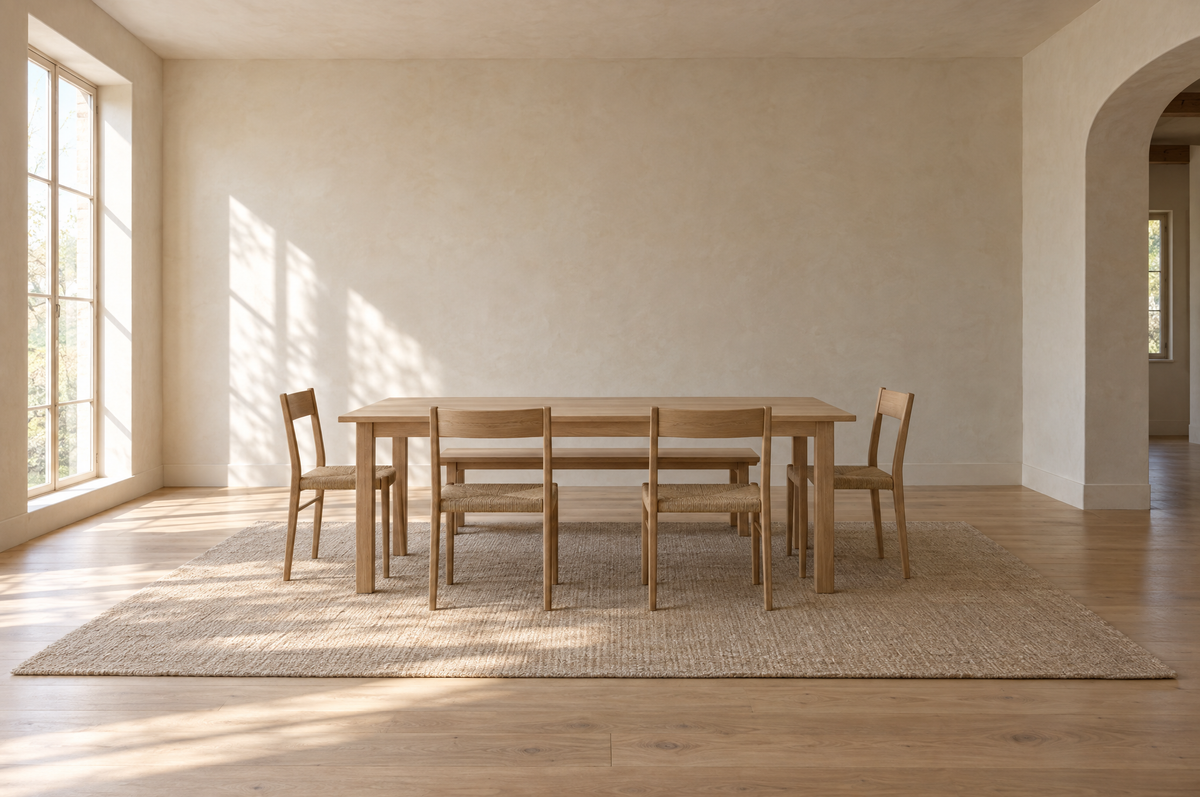
Dining Table Height, Chair Fit and Rug Size: The Measurements That Actually Matter
A standard dining table is 30 inches tall. A standard dining chair seat is 18 inches. Almost every fit problem at a dining table comes from one of those two numbers being different than assumed.
Search data shows height is the most-asked question in the category. Roughly 4,000 people a month type some version of "how tall is a dining table," and there is a reason: it is the one measurement that decides whether a table and a set of chairs work together, and it is rarely printed anywhere obvious.
The three numbers
| Measurement | Standard | Range |
|---|---|---|
| Dining table height | 30 inches | 28 to 30 |
| Dining chair seat height | 18 inches | 17 to 19 |
| Clearance between them | 12 inches | 10 to 12 |
Measure the table from the floor to the underside of the tabletop, not to the top surface. Tabletop thickness varies from half an inch to two inches, and the underside is what your legs meet. Our dining tables list height in the specifications for this reason.
If a table measures 30 inches to the underside and a chair seat is 18 inches, the clearance is 12 inches. That is comfortable for most adults. Below 10 inches, thighs press against the table. Above 13, the table sits too low and people hunch.
Armchairs need a fourth number
Dining chairs with arms only work if the arms clear the table apron, which is the horizontal rail under the tabletop on many designs.
Measure from the floor to the top of the chair arm. That number must be smaller than the distance from the floor to the bottom of the apron, or the chair will not push in. On a 30 inch table with a 4 inch apron, the underside of the apron sits at 26 inches, so chair arms need to be under 26 inches tall.
Pedestal and trestle tables have no apron, which is why armchairs almost always fit them. The 60 inch farmhouse trestle table is a straightforward example: 30 inches to the top, a central trestle instead of a rail, and nothing at the corners for an arm to hit.
How many people actually fit
The working rule is 24 inches of table edge per person. That is the width one adult needs to eat without touching elbows.
| Table size | Comfortably seats |
|---|---|
| 36 inch round | 2 to 3 |
| 48 inch round | 4 |
| 54 inch round | 5 |
| 60 inch round | 6 |
| 60 x 36 inch rectangular | 6 |
| 72 x 38 inch rectangular | 6, or 8 with the ends used |
| 96 x 40 inch rectangular | 8 to 10 |
Round tables lose capacity faster than rectangular ones as they shrink, because the usable edge is a circumference rather than four straight sides. A 48 inch round has about 150 inches of edge, which is six people at 24 inches each in theory, but the legs underneath collide. Four is the honest number.
Manufacturers routinely list the theoretical count rather than the comfortable one. A table sold as seating six often seats four well and six only if nobody minds contact.
Choosing chairs for a round table
Round tables take armless chairs better than rectangular ones do. The curved edge means chairs sit at slightly different angles to each other, and arms collide at the corners where two chairs meet.
Count chairs by the table's circumference rather than its diameter. Multiply the diameter by 3.14, then divide by 24. A 60 inch round gives about 188 inches of edge, which is seven at 24 inches each, but the pedestal or legs cut that to six in practice.
Chair back height matters more on a round table too, because you see the backs from every angle rather than from one end. Low or open backs keep a round table from looking crowded.
Bench or chairs
A bench on one side and chairs on the other is the most common arrangement, and it works for specific reasons rather than aesthetic ones.
A bench seats more people in the same length. Chairs need 24 inches each. A bench needs about 20 per person because there are no chair frames between diners. A 60 inch bench seats three comfortably where three chairs would need 72 inches.
A bench tucks fully under the table, so it disappears when not in use. In a small room that is the difference between a walkway and a squeeze.
A bench has no back. That is fine for a quick weeknight dinner and uncomfortable for a three hour holiday meal. This is the actual trade, not the look.
Match bench seat height to chair seat height, 17 to 19 inches, and keep the bench 6 to 12 inches shorter than the table so it does not stick out past the ends.
The common compromise is a bench on the window or wall side, where nobody wants to squeeze behind a chair, and chairs on the open side and at the ends.
Do the chairs have to match the table
No, and matched dining sets have become the less common choice.
What has to be consistent is seat height and scale. Chairs at 18 inches and a bench at 18 inches read as a set even in different materials. A 16 inch chair next to a 19 inch bench reads as a mistake regardless of finish.
Wood tone is the easiest thing to mismatch successfully, because floors, tables and chairs almost never match in a real room anyway. Metal and wood, upholstered and caned, walnut table with black chairs are all standard.
Upholstered dining chairs are more comfortable than wood or metal for long meals, and the trade is cleaning. Performance fabric and removable covers make that manageable; untreated linen on a chair where children eat does not.
The rug rule almost everyone gets wrong
Nearly 2,000 people a month search some version of "what size rug under dining table," and the common answer of "bigger than the table" is the wrong answer.
The rug has to extend at least 24 inches, ideally 30, past the table edge on every side. Not because of how it looks, but because a chair pulled out to sit down must still have all four legs on the rug. A chair with two legs on and two off catches every time someone stands up.
| Table size | Minimum rug |
|---|---|
| 48 inch round | 8 foot round or 8 x 10 |
| 60 inch round | 9 foot round or 9 x 12 |
| 60 x 36 rectangular | 8 x 10 |
| 72 x 38 rectangular | 9 x 12 |
| 96 x 40 rectangular | 10 x 14 |
This is why dining rugs run so much larger than living room rugs for the same footprint. An 8 x 10 under a six foot table looks oversized in a showroom photo and is correct in a real room.
Counter and bar height are different furniture
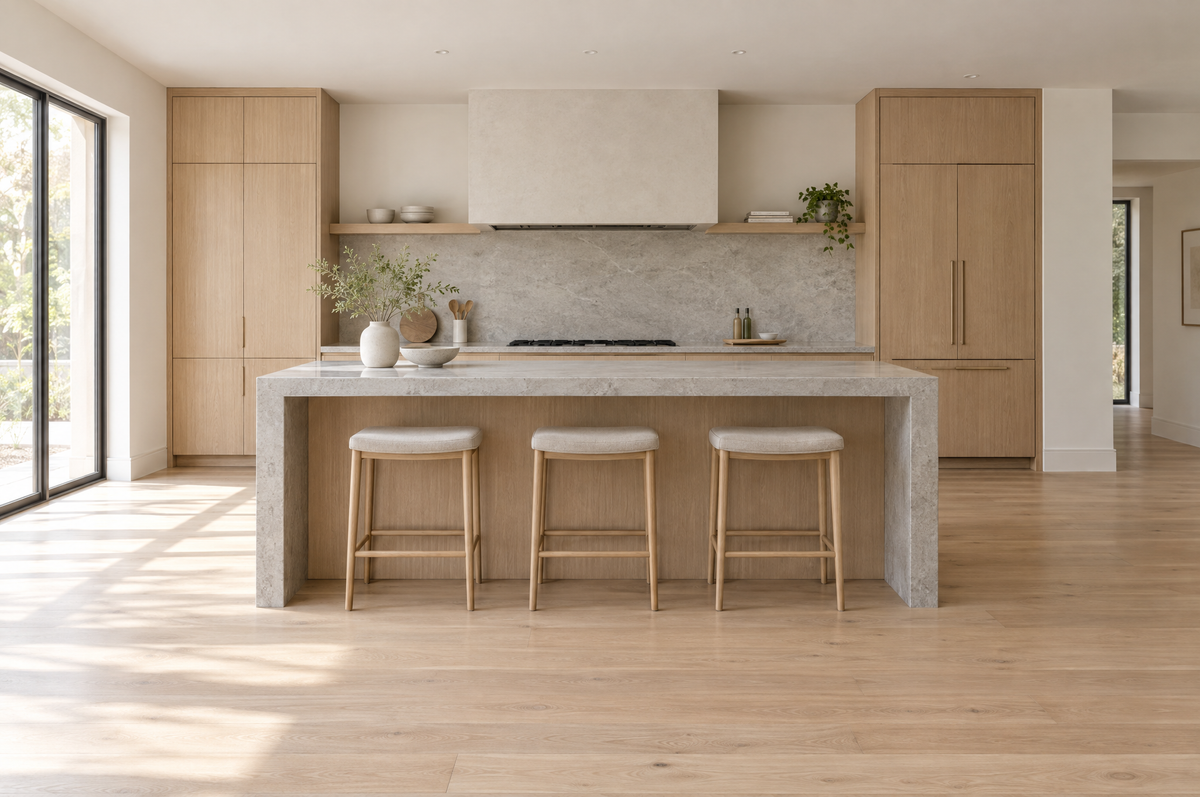
A 30 inch dining table takes a 17 to 19 inch chair. A 36 inch kitchen counter takes a 24 to 26 inch counter stool. A 42 inch bar takes a 29 to 31 inch bar stool.
Those are three separate height classes and they are not interchangeable. The same 12 inch clearance rule governs all three, which is the useful thing to remember: whatever the surface height, subtract 12 and that is the seat you need.
Before you buy
Measure floor to underside of your current table, if you have one you like. That single number tells you more than any product description.
Measure the room. A dining table needs 36 inches of clearance behind each chair for someone to walk past, and 48 inches if that path is a main route through the room.
Check whether the table has an apron if you want armchairs.
Match seat heights across chairs and benches, and let the materials differ.
And buy the rug to the table, not to the room.
Frequently asked questions
How tall is a standard dining table?
A standard dining table is 30 inches tall, with most tables falling between 28 and 30 inches. Measure from the floor to the underside of the tabletop rather than the top surface, because tabletop thickness varies from half an inch to two inches and the underside is what your legs meet.
How much space should there be between a dining chair and the table?
Aim for 12 inches of clearance between the chair seat and the underside of the table, with 10 to 12 inches being the workable range. A 30 inch table with an 18 inch chair seat gives exactly 12 inches. Below 10 inches thighs press against the table, and above 13 inches people hunch.
How many people fit at a dining table?
Allow 24 inches of table edge per person. That means a 48 inch round seats four, a 60 inch round seats six, a 60 by 36 inch rectangular table seats six, and a 96 by 40 inch table seats eight to ten. Manufacturers often list the theoretical count rather than the comfortable one.
Will armchairs fit under my dining table?
Measure from the floor to the top of the chair arm and compare it to the distance from the floor to the bottom of the table apron, which is the horizontal rail under the tabletop. On a 30 inch table with a 4 inch apron the apron sits at 26 inches, so arms must be under 26 inches. Pedestal and trestle tables have no apron, which is why armchairs almost always fit them.
What size rug goes under a dining table?
The rug must extend at least 24 inches past the table edge on every side, ideally 30 inches, so a chair pulled out to sit down still has all four legs on the rug. A 60 by 36 inch table needs an 8 by 10 rug, and a 72 by 38 inch table needs a 9 by 12.
Do dining chairs have to match the table?
No. What has to be consistent is seat height and scale. Chairs at 18 inches and a bench at 18 inches read as a set even in different materials, while a 16 inch chair next to a 19 inch bench reads as a mistake regardless of finish. Wood tone is the easiest thing to mismatch successfully.
Methodology
Search volume and question data are from Semrush, United States database, pulled August 2026, sorted by monthly volume. Dimension standards reflect common North American residential furniture manufacturing and are consistent across major retailers; individual products vary and the product specification is always the authority.
Two Seventy Nine publishes table height and seat height in the specifications on its dining listings, so the clearance math is possible before you order. If a number you need is missing from a listing, ask us and we will get it from the manufacturer.