How to Pick a Coffee Table: Size, Shape, Height and Storage
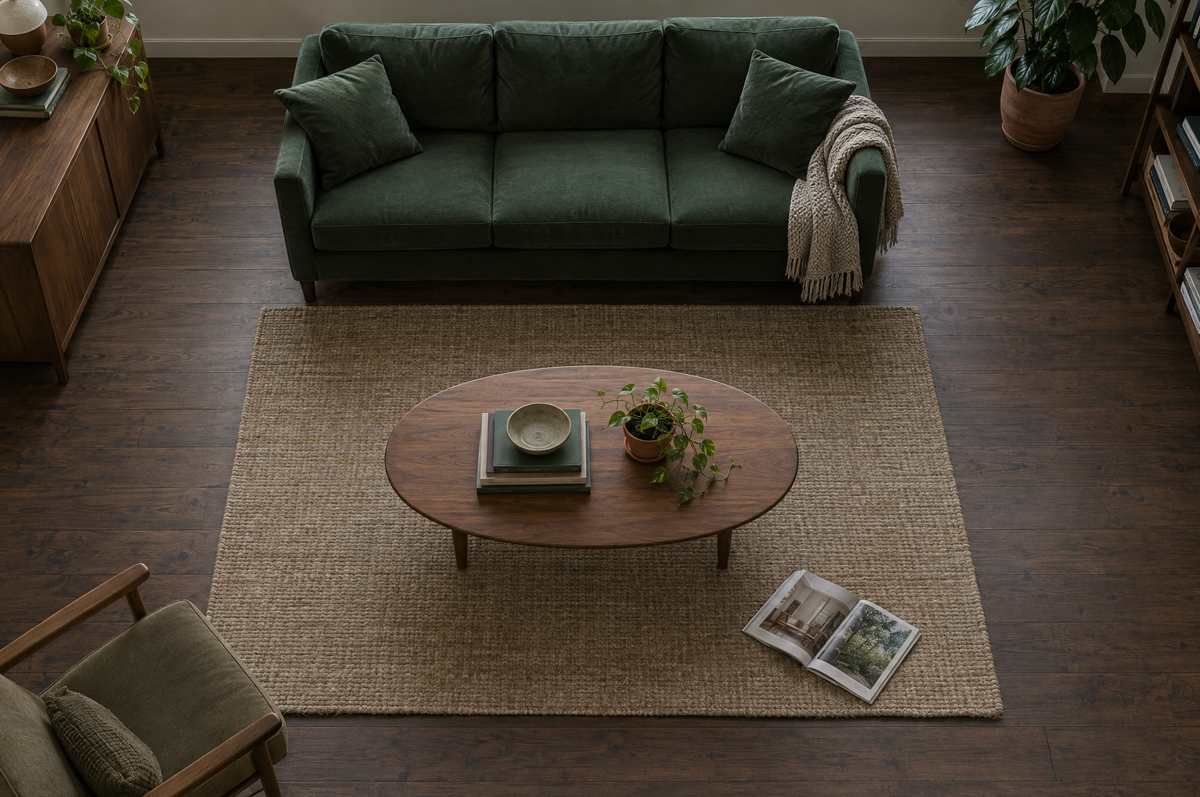
Pick a coffee table by working outward from the sofa, in this order: length first, then height, then the gap around it. Aim for a table about two thirds the length of the sofa, a top within roughly two inches of the sofa's seat height, and 14 to 18 inches of open floor between the table edge and the sofa front. Shape, material and storage come after those three numbers, because a beautiful table at the wrong height is still the wrong table.
Most people shop the other way round. They find a table they like, measure nothing, and discover at home that it is too tall to reach over or too short to see past. The three measurements above take about five minutes with a tape measure and rule out most of the catalogue before you ever look at a finish.
Start with the length of your sofa
Measure your sofa end to end, including the arms, then take about two thirds of that. An 84 inch sofa points to a table somewhere around 50 to 56 inches. A 72 inch loveseat points to roughly 44 to 48 inches. This is a proportion guideline rather than a rule, and it exists so the table reads as part of the seating group instead of a separate object stranded on the rug.
Published widths in our coffee table collection run from about 27.5 inches up to 53.4 inches, so a standard three seat sofa has plenty of matches and a sectional usually needs the upper end of that range or two smaller tables pushed together.
Depth matters less, but it still has a floor. Anything under about 20 inches deep starts to feel like a bench. Our deeper rectangular and oval tops sit between 22 and 34 inches, which is enough for a tray and a laptop without crowding the walkway.
Match the height to the seat, not to the room
The useful comparison is the table top against the sofa seat cushion. Level with the seat, or up to two inches below it, is the range where you can set a mug down without leaning forward or reaching up. Seat height is published in the specifications on each sofa listing, so you can check it before you buy rather than guessing from a photo.
Coffee table heights vary more than people expect. Across our active tables the published heights run from 11.2 inches on the low fiberglass slab shapes to 20.6 inches on the taller glass topped pedestal styles. That is a nine inch spread, which is the difference between a table you lounge over and a table you could almost eat at.
Low tables suit deep, low seating. Taller tables suit upright sofas with firm, high cushions. If your sofa sits high and you choose an 11 inch table, every drink becomes a stretch. We go deeper on this in our guide to how high a coffee table should be.
Leave room to walk and to reach
Two gaps decide whether a room works day to day. The first is between the sofa and the table, where 14 to 18 inches is the usual target. Closer than 14 and people clip their shins getting in. Further than 18 and you cannot reach your cup without standing.
The second is the walkway around the rest of the table, where 30 to 36 inches is the comfortable range for a main route through the room. In a tight apartment you can drop that to around 24 inches on a side nobody uses as a path. Our breakdown of how far a coffee table should sit from the couch covers the edge cases.
Do the subtraction before you shop. Measure the clear floor between your sofa and the wall or media unit, subtract 16 inches for the sofa gap and 30 inches for the walkway, and whatever is left is the maximum depth your table can be.
Let the traffic pattern pick the shape
Shape is usually treated as a style decision. It is mostly a circulation decision.
- Rectangular suits a long sofa facing a wall or a television. It fills the length and keeps the lines parallel.
- Oval does the same job with the corners taken off, which helps in a narrow room or a house with small children. Our walnut solid wood oval coffee table is 47.2 inches wide and only 22.1 inches deep, which is a useful footprint when the walkway is tight.
- Round works where people approach from several directions, or where a sharp corner would sit in a doorway. Most of our round coffee tables fall between 27.5 and 35.4 inches across.
- Square suits L shaped sectionals, where a long rectangle leaves an awkward wedge of floor.
The top material decides your upkeep
This is where the honest trade-offs live, and it is worth reading the construction line on a listing rather than the headline description.
Solid wood takes dents but can be sanded and refinished, so it ages rather than fails. Wood veneer over MDF gives you a stable, flat top that will not warp in a dry apartment, and the panel core is simply how most modern case goods are built. It will not survive standing water at a seam, so wipe spills rather than letting them sit. Tempered glass shows every fingerprint and every ring, and wants cleaning more often than any other top, but it also makes a small room read as larger because you can see the floor through it. Fiberglass and mineral composite tops give you sculptural shapes that wood cannot hold, and they are heavy for their size.
Weight is a decent proxy for how a table will feel in use. Published weights across our active tables run from about 17 pounds for a slim glass and wood frame up to 65.7 pounds for a solid wood and panel lift-top. A 17 pound table slides when you put your feet on it. A 60 pound table does not move at all, which is good until you need to vacuum under it.
Decide about storage before you fall for a finish
An open frame table looks lighter and photographs better. A table with a shelf, drawers or a lifting top absorbs the remote controls, coasters and chargers that otherwise live on the surface.
If your living room doubles as a workspace, a lift-top is worth the bulk. Ours include a 31.1 inch square lift-top coffee table in natural wood that sits at 15.4 inches closed, which is a normal coffee table height until you raise it to work. The full range sits in our lift-top coffee tables, and the broader coffee tables with storage collection covers shelves and drawers.
Check the weight limit before you load it
Coffee tables get treated as seats, footrests and buffet tables, and not all of them are built for it. Where a supplier publishes a limit we list it. Our glass topped pedestal tables, for example, publish a 50 pound weight capacity, which comfortably covers books, trays and a laptop but is not an invitation to sit on it.
If you expect a table to take real abuse, read for a solid wood or metal base and a published capacity rather than assuming. Where no capacity is listed, treat the table as a surface and not as furniture you stand on.
Real dimensions from our catalogue
These are published supplier specifications for tables we currently stock, chosen to show the spread rather than to rank them.
| Table | Shape | Width x Depth x Height (in) | Weight |
|---|---|---|---|
| White round, 27.5 in | Round | 27.5 x 27.5 x 15.3 | 18.4 lbs |
| Walnut round fluted, 30.3 in | Round | 30.3 x 30.3 x 13.0 | 27.7 lbs |
| Natural glass top round, 31.1 in | Round | 31.1 x 31.1 x 15.8 | 17.0 lbs |
| Natural square lift-top, 31.1 in | Square | 31.1 x 31.1 x 15.4 | 65.7 lbs |
| Walnut glass top, 31.5 in | Petal | 31.5 x 31.5 x 20.6 | 24.2 lbs |
| Beige round, 35.4 in | Round | 35.4 x 35.4 x 13.8 | 50.6 lbs |
| Walnut rectangular, 47.2 in | Rectangular | 47.2 x 23.6 x 16.3 | 52.0 lbs |
| Walnut solid wood oval, 47.2 in | Oval | 47.2 x 22.1 x 16.5 | 17.2 lbs |
| Gray slab, 53.4 in | Freeform | 53.4 x 33.7 x 11.2 | 57.3 lbs |
Once the table is home, the surface itself is a separate problem. Our guide to styling a coffee table covers what to actually put on it.
Frequently asked questions
What size coffee table should I get for a 3-seat sofa?
A standard three seat sofa runs roughly 72 to 84 inches wide, which points to a coffee table between about 48 and 56 inches long. Measure your own sofa including the arms and take two thirds of that figure. If you land between two sizes, go smaller, because the walkway around the table matters more than filling the space.
How tall should a coffee table be?
Aim for a top that is level with your sofa's seat cushion or up to two inches below it. That is the range where you can set something down without leaning forward or reaching up. Published coffee table heights vary widely, from around 11 inches on low slab shapes to over 20 inches on taller pedestal styles, so check the height on the listing against the seat height on your sofa.
Is a round or rectangular coffee table better for a small room?
Round usually wins in a small room, for two reasons. There are no corners to catch a hip in a tight walkway, and the curve reads as taking up less floor even when the footprint is similar. A rectangular table is the better choice when your sofa is long and faces a wall, because it keeps the lines of the room parallel.
Does a coffee table need to match the other wood in the room?
No, and trying to match exactly usually looks worse than not trying. Woods from different suppliers rarely match, and a near miss is more noticeable than a clear contrast. Pick a tone that is obviously different from your floor and your other case goods, or go to a non wood top such as glass or stone-look composite and let the other pieces carry the wood.
How much weight can a coffee table hold?
It depends on the base and the top, and only some tables publish a figure. Where a supplier gives one we list it on the product page, and our glass topped pedestal tables publish a 50 pound capacity as an example. A published capacity covers normal use such as books, trays and a laptop. No coffee table should be treated as a step stool or a seat unless it is specifically described as one.
About these numbers
Dimensions, weights and capacities in this article come from supplier written specifications attached to the products we currently stock, not from our own measurements, and they describe those specific tables rather than the category as a whole. Suppliers round differently, so treat a published figure as accurate to roughly half an inch and measure your own room rather than relying on ours. The proportional guidance on sofa length, seat height and walkway clearance is common interior design practice rather than a published standard, and it is a starting point you should break when your room asks you to.