
What Is a Sectional Sofa? Shapes, Sizes and How to Pick One
A sectional sofa is a seat built from two or more joined pieces that form a single continuous run, usually bending around a corner. That bend is the whole point. Instead of one straight bench about 30 inches deep, you get a shape that is 50 to 95 inches deep on its long side, seats four to six people facing each other, and fills a corner that a regular sofa leaves awkward. The trade is floor space and flexibility: a sectional claims a corner and commits to it, unless it is a modular one you can pull apart and rearrange.
The three shapes you will actually see
Almost every sectional on the market is one of three layouts, and the names get used loosely, so it helps to know what each one actually does to a room.
L-shaped. One long run plus a shorter return at ninety degrees. This is the default sectional and the one most people picture. It tucks into a corner, gives one person a place to stretch out, and keeps the rest of the room open. Our L-shaped couches are the largest group we carry for a reason.
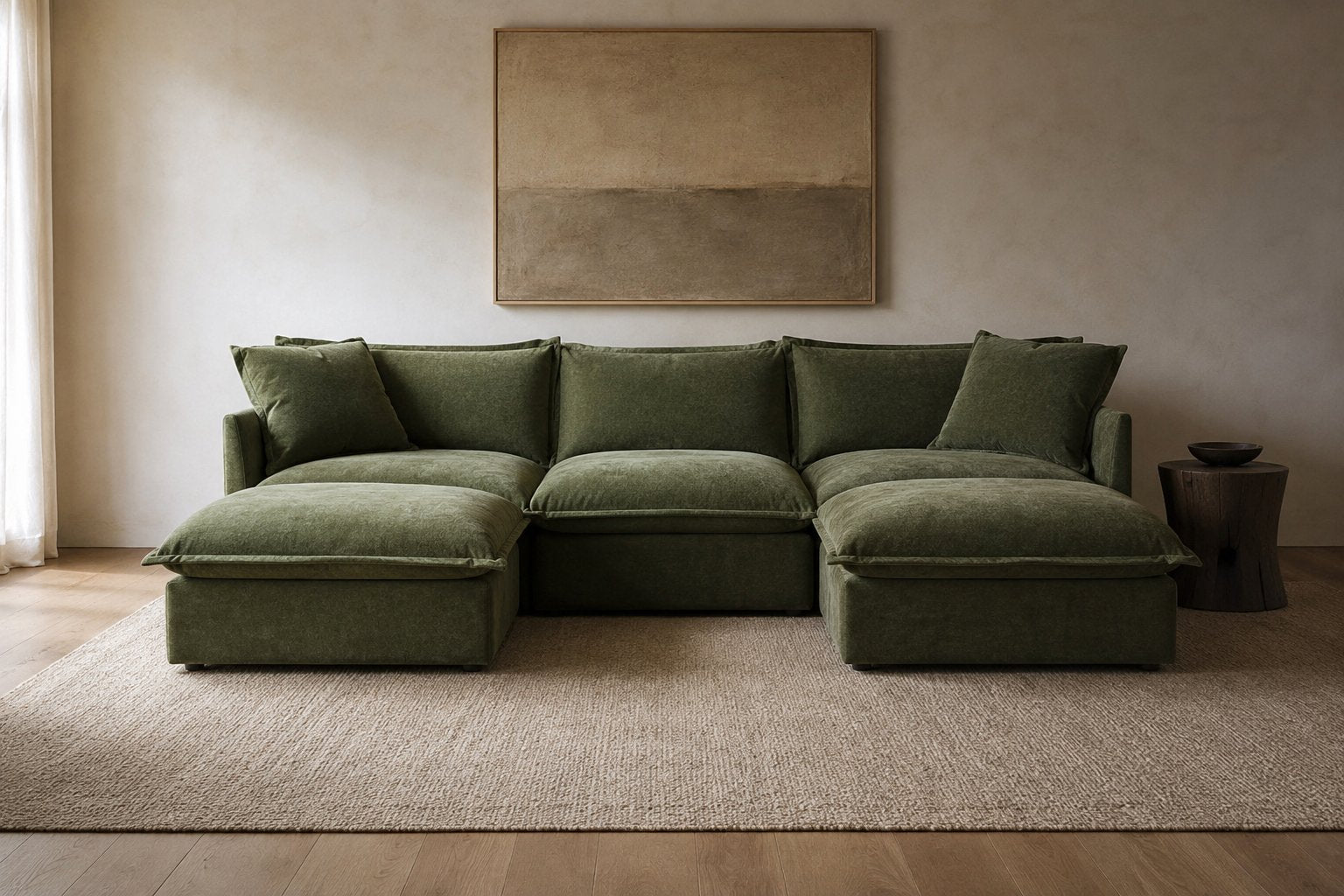
U-shaped. A long run with a return on both ends. It seats the most people and creates a conversation pit effect, but it eats a room. The U-shaped sectionals we list run wide and deep, and they generally want a dedicated room rather than a shared living and dining space.
Modular. Separate pieces that sit together without being permanently fixed. You can run them as an L today, straighten them into a long sofa next year, or split off a piece as a stand-alone chair. Modular couches are the ones worth looking at if you move often or have not settled on a layout.
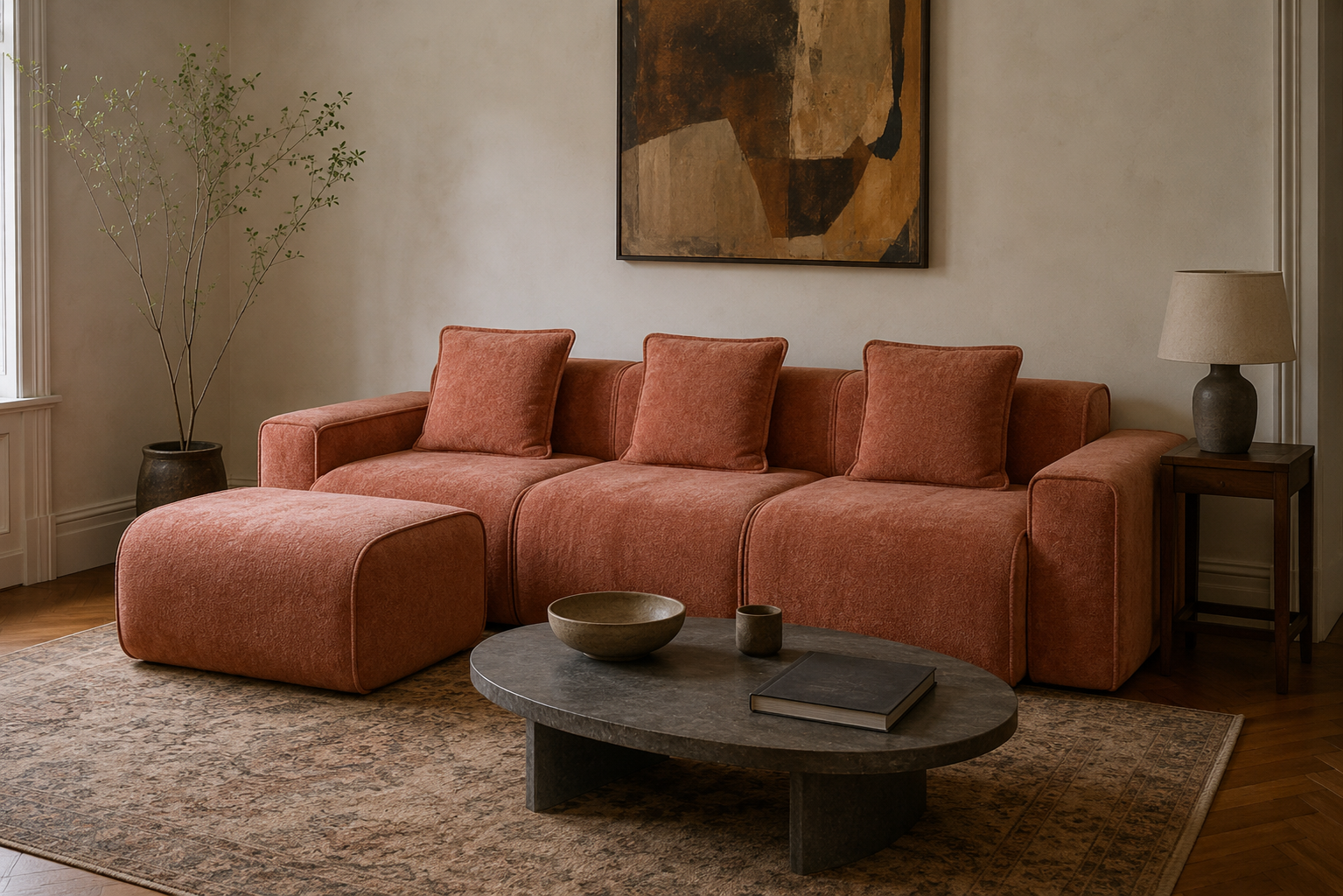
A fourth term, "couch with chaise", sometimes gets sold as a sectional and sometimes as a sofa. It is a two-piece unit where the short return has no back and no arm. Functionally it behaves like a small L.
Real sectional dimensions from our catalogue
Category guides tend to quote round numbers. Here are actual published figures from listings on this site, so you can see the spread rather than an average.
| Piece | Shape | Overall size (W x D x H) | Seats | Weight |
|---|---|---|---|---|
| Black Corduroy L-Shaped Sectional with 2 Ottomans | L-shaped | 95 x 59.4 x 28 in | 5 | 102.1 lb |
| Green Corduroy L-Shaped Sectional, Right-Facing | L-shaped | 103.2 x 67.8 x 32.3 in | 3 | 94.6 lb |
| White Corduroy Modular Sectional | Modular | 104 x 68.9 x 23.6 in | 4 | 91 lb |
| Black Corduroy L-Shaped Reclining Sectional | L-shaped, reclining | 107 x 70 x 34 in | 6 | 135.3 lb |
| Green Chenille L-Shaped Sleeper Sectional | L-shaped sleeper | 118 x 86.6 x 36.3 in | 6 | 250.4 lb |
| Gray U-Shaped Sleeper Sectional, Right-Facing | U-shaped sleeper | 122 x 95.6 x 38.6 in | 6 | 386 lb |
| Green Corduroy U-Shaped Sectional with Ottoman | U-shaped | 135 x 68.2 x 37.8 in | 4 | 158.1 lb |
Two things jump out of that table. Width runs from the mid-90s to the mid-130s, a range of more than three feet. And seat count does not track width the way you would expect: a 95 inch piece is rated for five seats while a 135 inch piece is rated for four, because the second one spends its width on a deeper return and an ottoman. Read the seat count and the dimensions together, never one alone.
Sectional or regular sofa? Depth is the real difference
People compare sectionals and sofas on width. Width is not where they differ most.
| Type | Example from our catalogue | Width | Depth |
|---|---|---|---|
| Three-seat sofa | Black Velvet 3-Seat Chesterfield Sofa | 80 in | 29 in |
| Three-seat sofa | Black Vegan Leather 3-Seat Chesterfield Sofa | 84.7 in | 32.1 in |
| L-shaped sectional | Green Corduroy L-Shaped Sectional | 103.2 in | 67.8 in |
| U-shaped sectional | Gray U-Shaped Sleeper Sectional | 122 in | 95.6 in |
A three-seat sofa is roughly 29 to 32 inches deep. A sectional is roughly 50 to 95 inches deep once you count the return. That is double to triple the floor footprint, and it is why a sectional that looks fine on paper can swallow a room that handled a sofa comfortably. If your room is tight, the honest answer is often a straight sofa or a loveseat, some of which run as narrow as 56 inches, rather than a smaller sectional.
Seat height is worth a glance too. Among our upholstered pieces, published seat heights sit around 17 to 19 inches from the floor. Lower seats read more casual and are harder to get out of. Higher seats suit anyone who wants to stand up without a push.
How to measure before you order one
Three measurements decide whether a sectional works, and only one of them is the sofa itself.
- The wall run. Measure the two walls the sectional will sit against, corner outward. Subtract a few inches at each end so the piece is not jammed against a door casing or a radiator.
- The walkway. Interior designers generally leave 30 to 36 inches of clear path anywhere people regularly walk. Measure from the front edge of the sectional to whatever it faces. If that gap drops under 30 inches, the room will feel wrong no matter how good the sofa is.
- The route in. Standard interior doors in US homes are commonly 30 or 32 inches wide, and a front door is usually 36. Measure your narrowest doorway, any stair turn, and the elevator if you have one.
That third one is where sectionals have an advantage over one-piece sofas. Because a sectional ships as separate pieces, each box is smaller than the assembled footprint. Several of our sectionals also arrive with no assembly required, which means the pieces simply sit together once they are in the room. Box counts and assembly requirements are published in the specifications on each listing, so check them before delivery day rather than after.
Left-facing and right-facing, explained once
This trips up more orders than anything else, and the reason is that the label is written from the seated point of view, not the standing one. A right-facing sectional has its chaise or long return on your right when you are sitting on it. Walk into the room and look at that same piece, and the return now appears on your left, because you have turned around.
So the rule is simple: sit down in your head first, then read the label. When in doubt, ignore the wording and look at the photograph, then confirm against the listing. A right-facing L-shaped sectional and its mirror image are not interchangeable once the piece is out of the box.
Reversible chaise designs sidestep the problem entirely. The olive green sleeper sectional at 71 inches wide has a chaise that can be set on either side, so the same piece works in either corner. If you are not certain about your layout, or you expect to move, reversible is the safer buy.
Sectionals that do a second job
A large share of sectionals now double as guest beds or add storage, and the specifications tell you whether the second job is done properly.
Look for a published sleeping surface, not just the word "sleeper". Our 118 inch chenille sleeper sectional lists a sleeping surface of 79 by 104.7 inches with a 17.8 inch seat height, an iron and plywood frame, and removable cushion and backrest covers. A king sleeper version at 88.2 inches wide lists a 76 by 80 inch sleeping surface. Those are figures you can hold a mattress sheet up against. A listing that says "converts to a bed" without a dimension is telling you less than it seems.
Storage is the other common extra. Chaise sections with lifting seats swallow blankets and spare pillows, which matters more in a small apartment than an extra six inches of seat.
What to check on the listing before you buy
- Frame material. Plywood and iron, solid wood, or an all-foam body with no wood frame at all. Each behaves differently over years of use, and each is stated plainly where the supplier states it.
- Cushion fill. Foam is the norm. Some pieces use foam with pocket springs under the seat, which resists sagging better than foam alone.
- Removable covers. If the cushion and backrest covers come off, cleaning is a different proposition entirely. This is published per listing.
- Weight. A 386 pound sectional is not a piece you reposition on a whim. A 91 pound one is.
- Assembly. Some pieces need tools, some do not. It is stated on the listing.
Outbound shipping is free. Returns run 30 days, and return shipping is the customer's cost, so measuring carefully up front is worth the ten minutes. Browse the full range of sectionals, or narrow to small sectionals if your room is under pressure.
Frequently asked questions
Is a sectional the same as an L-shaped couch?
An L-shaped couch is one kind of sectional, the most common kind. "Sectional" describes any sofa built from multiple joined pieces, which also covers U-shaped layouts and modular sets that can be rearranged. So every L-shaped couch is a sectional, but not every sectional is L-shaped.
How much space does a sectional need?
Take the sectional's published overall width and depth, then add 30 to 36 inches of clear walkway on any side people pass. For an L-shaped piece around 103 inches wide and 68 inches deep, that means a usable zone of roughly 133 by 98 inches once one walkway is allowed. Measure the wall run corner outward before ordering, not the room's total square footage.
What does left-facing or right-facing mean?
The orientation is named from the point of view of someone sitting on the sofa, not someone looking at it. A right-facing sectional has its chaise or return on your right while you are seated, which places it on your left as you walk in. Check the product photograph against the listing before ordering, because a mirrored piece cannot be swapped after delivery.
Can a sectional work in a small living room?
Sometimes, but depth is the constraint rather than width. A three-seat sofa is about 29 to 32 inches deep while a sectional runs 50 inches deep or more, so a sectional can take double the floor area of a sofa with a similar footprint on the wall. In a tight room, a loveseat or a compact L-shaped piece usually works better than a scaled-down U-shape.
Do sectionals come apart for delivery?
Yes. A sectional ships as separate pieces, which is why it can fit through a 30 inch doorway that a one-piece sofa of the same seating capacity could not. Box count and whether any assembly is required are published in the specifications on each listing, and several of our sectionals need no assembly at all.
Is a modular sectional better than a fixed one?
It depends on how settled you are. Modular pieces sit together rather than locking together, so you can change the layout, straighten the run, or split off a section as a separate chair. A fixed sectional holds its shape more firmly and tends to have a cleaner seam line. If you move often or have not decided on a layout, modular is the more forgiving choice.
A note on sources
All dimensions, weights, seat counts, frame materials and sleeping surfaces in this article are taken from the supplier specifications published on the individual product listings on this site, captured in September 2026. Those figures come from suppliers rather than our own measurement, and suppliers note that manual measurement carries some tolerance, so treat them as accurate to within a fraction of an inch rather than exact. Specifications change as ranges are updated, so the listing is always the authority. The walkway and doorway guidance reflects widely published interior design and residential construction conventions in the US, not a measurement of your home. Nothing here is based on our own product testing.