How Long Do Sofas Last? Frame, Foam and Fabric, and Which One Fails First
Most sofas last 7 to 15 years. A frame-built sofa that gets daily use in a family living room tends to land near the bottom of that range, and a lightly used one in a formal room can pass the top of it. The frame sets the ceiling, the foam decides how quickly the sofa stops feeling new, and the fabric usually gives out before either of them. If you want a number to plan around, budget for 10 years and expect the cushions, not the structure, to be what makes you replace it.
That range gets repeated a lot without much behind it, so the rest of this page is about the parts that actually move it. Three things decide how long your sofa lasts: what holds it up, what you sit on, and what covers it. They fail on different schedules, and only one of them is usually worth fixing.
Lifespan by what the sofa is built from
These are the working ranges for normal household use, meaning a sofa that gets sat on most days by adults and occasionally slept on. Heavy daily use with kids pulls every row down. A guest room sofa pushes every row up.
| Build | Typical service life | What usually ends it |
|---|---|---|
| Solid hardwood frame, high resilience foam | 12 to 20 years | Fabric wear or a change in taste |
| Hardwood and plywood frame, standard foam | 8 to 15 years | Cushions flatten before the frame moves |
| Softwood or particleboard frame | 3 to 7 years | Joints loosen, the frame racks side to side |
| Modular foam-block sofa, no rigid frame | 7 to 12 years | Foam compression, cover wear |
| Sleeper sofa with a folding mechanism | 7 to 12 years | The mechanism, usually before the upholstery |
The gap between the top row and the bottom row is roughly a factor of four, and it is almost entirely a frame question. That is why the frame is worth reading about before the fabric, even though the fabric is what you look at in the photos.
The frame sets the ceiling
A sofa frame is a box that has to resist being pushed out of square thousands of times. Every time someone drops onto one end, the joints take a twisting load. Solid hardwood with corner blocks and glued, screwed joints resists that for decades. Stapled softwood does not, and once a frame starts to rack there is no repair that is cheaper than replacing the sofa.
Two things on a specification sheet tell you most of what you need. The first is the frame material. Rubberwood, a dense hardwood, and structural plywood panels both hold fasteners well. Particleboard and MDF are stable and flat and perfectly normal in furniture construction, but they hold a screw far less well than hardwood does, so where they appear matters more than whether they appear. Panels are fine. Load-bearing joints are not the place for them.
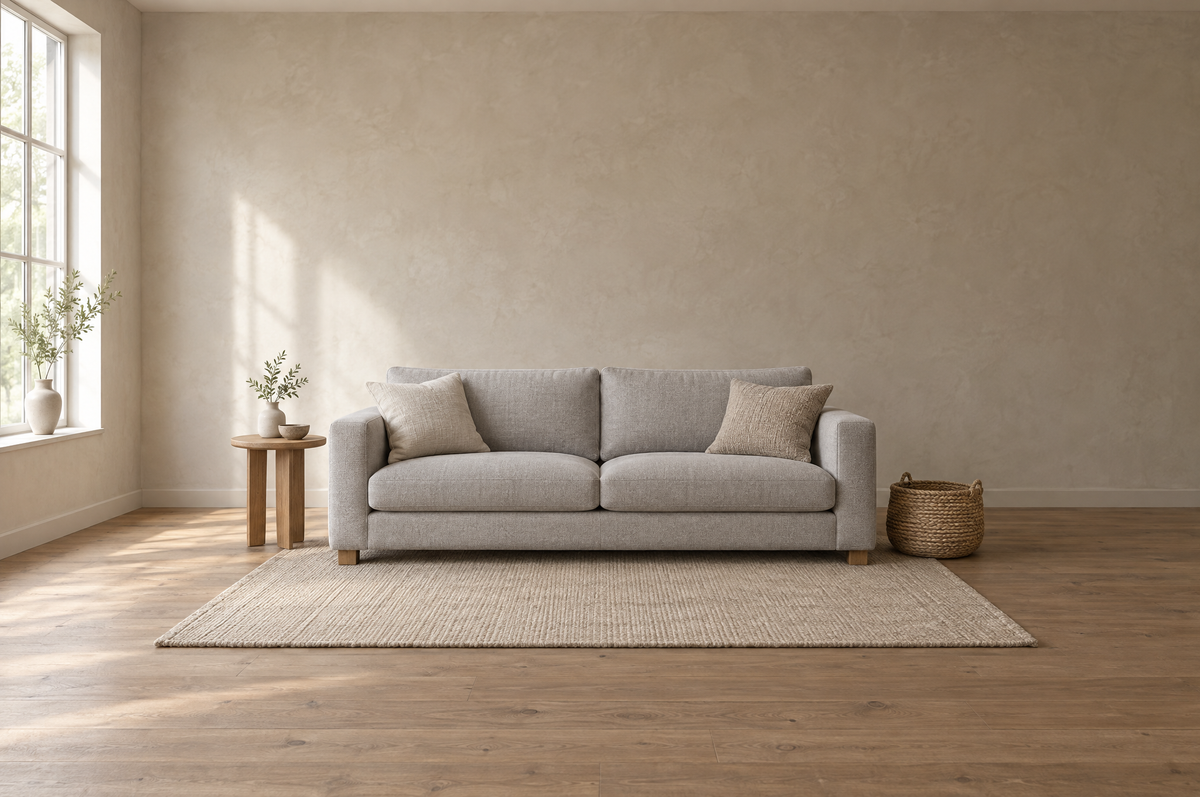
The second is leg support. A three-seat sofa with legs only at the four corners has an unsupported span in the middle, which is exactly where the heaviest person sits. Our White 3-Seat Couch, 79 in Wide is built on a rubberwood and plywood frame with solid wood legs plus an additional middle leg, and that center leg is doing more for its service life than any fabric choice could. It is the single cheapest piece of longevity engineering in upholstery.
Weight is a crude but useful proxy. Among the frame-built three-seat sofas in our catalogue, product weights commonly run between about 87 and 106 pounds. A three-seat sofa that arrives at 50 pounds has not found a lighter way to build a hardwood frame. It has found a way to use less of one.
Foam decides when it stops feeling new
Frames fail rarely and dramatically. Foam fails constantly and quietly, and it is the reason most people say their sofa "feels old" years before anything is structurally wrong.
Foam is rated by density, measured in pounds per cubic foot. Density is not firmness. A dense foam can be soft, and a cheap foam can feel firm when new and then collapse. Density is a measure of how much material is in the cushion, and therefore how much compression it can absorb before it stops springing back. High resilience foam is the grade that recovers its shape best over years of the same person sitting in the same spot. Standard polyurethane foam in the lower density grades is what produces the dip in the left-hand seat by year three.
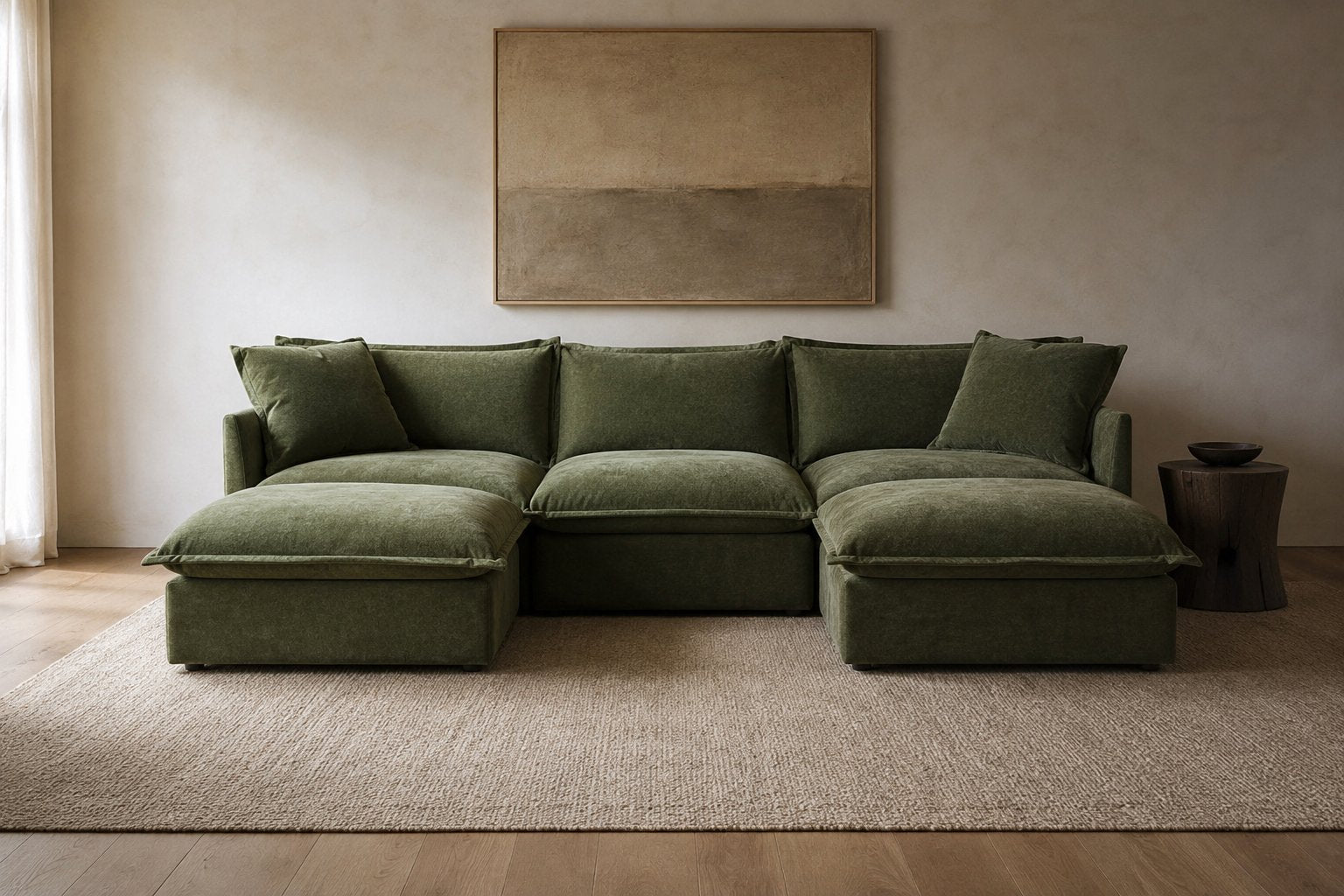
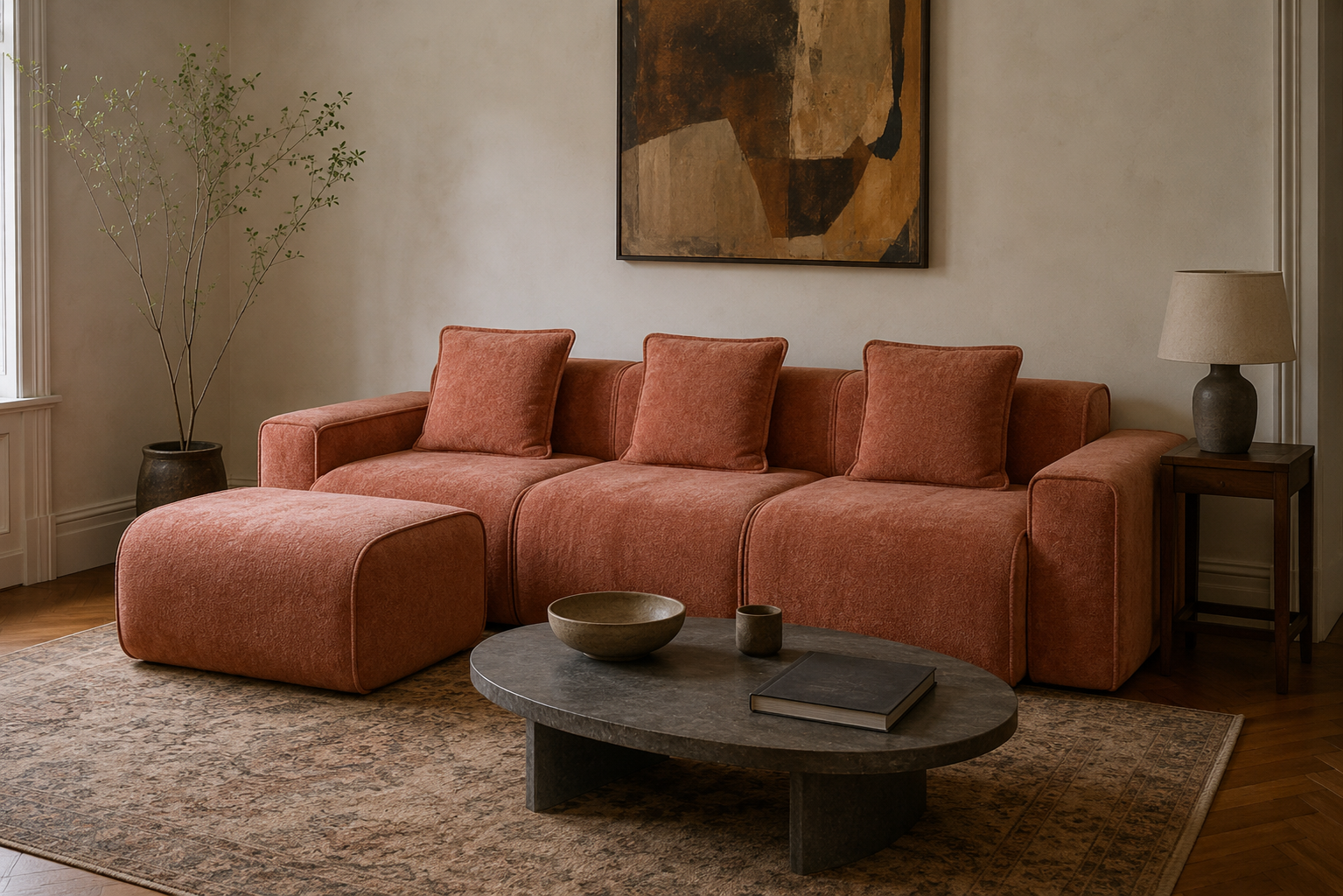
Cushions supported by springs under the foam last longer than foam alone, because the spring takes some of the load the foam would otherwise absorb. Our Beige Chenille 3-Seat Curved Sofa, 83.8 in Wide uses foam cushions over springs for that reason. On the modular side, the Big Fluffy Couch, 3-Seat Machine Washable Modular Sofa is filled with premium cotton and high resilience foam and publishes a weight capacity of 300 pounds per seat, with a 24 inch seat depth and an 18.7 inch seat height.
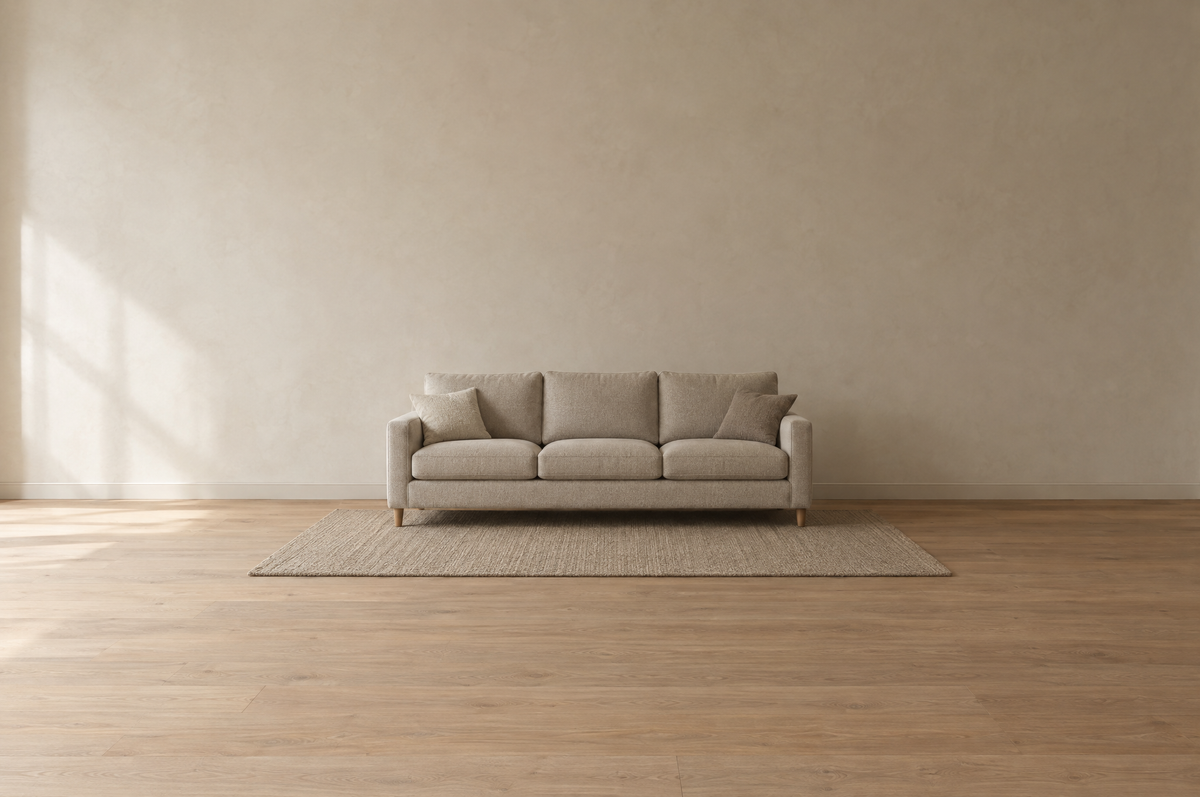
A published weight capacity is a useful signal on its own. It means someone tested the thing and was willing to put a number next to it. Supplier specifications on some frame-built models go further: the sheet for our Green Boucle 3-Seat Couch, 83 in Wide states the frame supports up to 900 pounds.
Fabric almost always goes first
On a well-built sofa the upholstery is the part with the shortest clock. It takes abrasion every single day, it takes sunlight, and it takes whatever gets spilled on it. A frame can be sound at year 15 under a cover that looked tired at year 6.
Fabric durability is measured in double rubs, a standardized abrasion test. Roughly speaking, 15,000 double rubs is light residential duty, 25,000 and up is heavy residential, and commercial-grade fabric starts around 30,000. Tightly woven fabrics with a low pile, like chenille and performance weaves, abrade more slowly than loose weaves. Bouclé has a looped texture that looks wonderful and snags on claws and zippers, which is worth knowing before you buy it rather than after.
Sunlight is the underrated one. A sofa in a south-facing window will fade unevenly in a few summers no matter what it cost. Rotating cushions and closing a blind in the afternoon costs nothing and buys years of appearance.
This is also where removable covers change the arithmetic. If the cover is the part that wears out and the cover comes off and goes in a washing machine, then the thing with the shortest lifespan becomes the thing you can refresh. Every sofa in The Big Fluffy Couch range is built that way, with covers you can remove and machine wash rather than spot-clean and hope.
What to read on a listing before you buy
You can make a decent durability judgment from a product page in about two minutes if you know what you are looking at.
- Frame material. Look for hardwood or structural plywood in the load-bearing parts. Where a listing publishes the construction, it is in the specifications.
- Leg count and middle support. On anything three seats or wider, a center leg matters.
- Fill type. High resilience foam, foam over springs, and foam with a fiber or cotton wrap all outlast plain low-density foam.
- Published weight capacity. A stated number beats an adjective.
- Product weight. Low weight for the size usually means less frame.
- Whether the covers come off. This decides whether a stain is an event or a wash cycle.
Dimensions, materials, product weight and fill are published in the specifications on each listing where the supplier provides them, so you can compare two sofas on the same fields rather than on marketing copy. You can work through our couches the same way.
How to add years to the sofa you have
None of this is exotic, and all of it works.
Rotate and flip the seat cushions every month or two so one seat does not take all the compression. Vacuum the crevices, because grit acts as an abrasive inside the weave every time someone sits down. Keep it out of direct afternoon sun. Do not sit on the arms, which is where frame joints break. Tighten the leg bolts once a year, since a loose leg puts a shear load on the frame corner. If the sofa has removable covers, wash them on the cycle the care label specifies rather than the hottest one available, because heat is what shrinks a cover so it no longer fits.
Repair or replace
The rule is simple. Fix what sits on the frame. Replace what the frame does.
Cushion inserts are the best value repair in furniture. New foam in an old sofa costs a fraction of a new sofa and restores most of what you miss about it. Replacement covers, where a manufacturer sells them, are similar. Reupholstery is a different proposition: a full reupholstery on a three-seat sofa commonly runs from several hundred dollars into the low thousands depending on yardage and labor rates, which puts it in the same range as buying new. That math only works on a frame worth keeping, meaning solid hardwood, or a piece you care about for reasons that are not financial.
A frame that creaks under normal sitting, rocks when you push the back, or has a visible sag along the seat rail is telling you the structure has gone. That is a replacement, not a repair.
Frequently asked questions
How long should a sofa last?
Plan on 10 years for a sofa in normal household use. A solid hardwood frame with high resilience foam can run 12 to 20 years, while a softwood or particleboard frame is often finished in 3 to 7. Daily use by a family shortens every one of those figures, and a sofa in a room nobody really uses can outlast all of them.
What part of a sofa wears out first?
The fabric, in almost every case, followed by the seat cushion foam. Both of those are the parts you can refresh. The frame is the part you cannot practically fix, and on a well-built sofa it is also the part least likely to fail.
Do more expensive sofas last longer?
Not automatically, but the things that make a sofa last do cost money to build in. Hardwood frames, denser foam and spring support all raise the price. Price paid for a designer name, an unusual shape or an imported fabric buys none of those things. Read the construction specifications rather than the price when you are trying to judge lifespan.
Is it worth reupholstering a sofa?
Only if the frame is worth the investment. Full reupholstery on a three-seat sofa often costs as much as replacing it, so it makes sense for solid hardwood frames and for pieces with sentimental value. Replacing just the cushion inserts is far cheaper and fixes the complaint most people actually have, which is that the seats have gone flat.
Does a sofa with washable covers last longer?
It stays looking new for longer, which is usually what determines when people replace a sofa. The frame and foam wear at the same rate either way, but a cover you can take off and machine wash means a spill or a season of dust does not permanently mark the piece.
How much weight can a sofa hold?
It depends on the model, and the only reliable answer is the one the manufacturer publishes. As examples from our own range, the Big Fluffy Couch modular sofas are rated at 300 pounds per seat, and the supplier specification for the Green Boucle 3-Seat Couch states the frame supports up to 900 pounds. Where a listing does not publish a figure, treat the absence as a reason to ask.
Sources and limits
Product figures on this page come from the specification records for those items in our own catalogue, including supplier-provided dimensions, product weights, fill descriptions and stated weight capacities. Those are supplier specifications rather than results from testing we conducted ourselves.
The lifespan ranges by build type are the working ranges commonly cited across the furniture trade and consumer guidance. They are rules of thumb, not measured results from a controlled study, and there is no published industry standard that assigns a service life to a sofa. Household use varies enormously, so treat the ranges as a way to compare builds against each other rather than as a prediction about your own sofa. Double rub figures refer to the standard Wyzenbeek abrasion test used for upholstery fabric, which measures abrasion resistance only and does not account for fading, soiling or snagging.
Shipping to you is free. Returns are accepted within 30 days, and return shipping is the customer's cost.