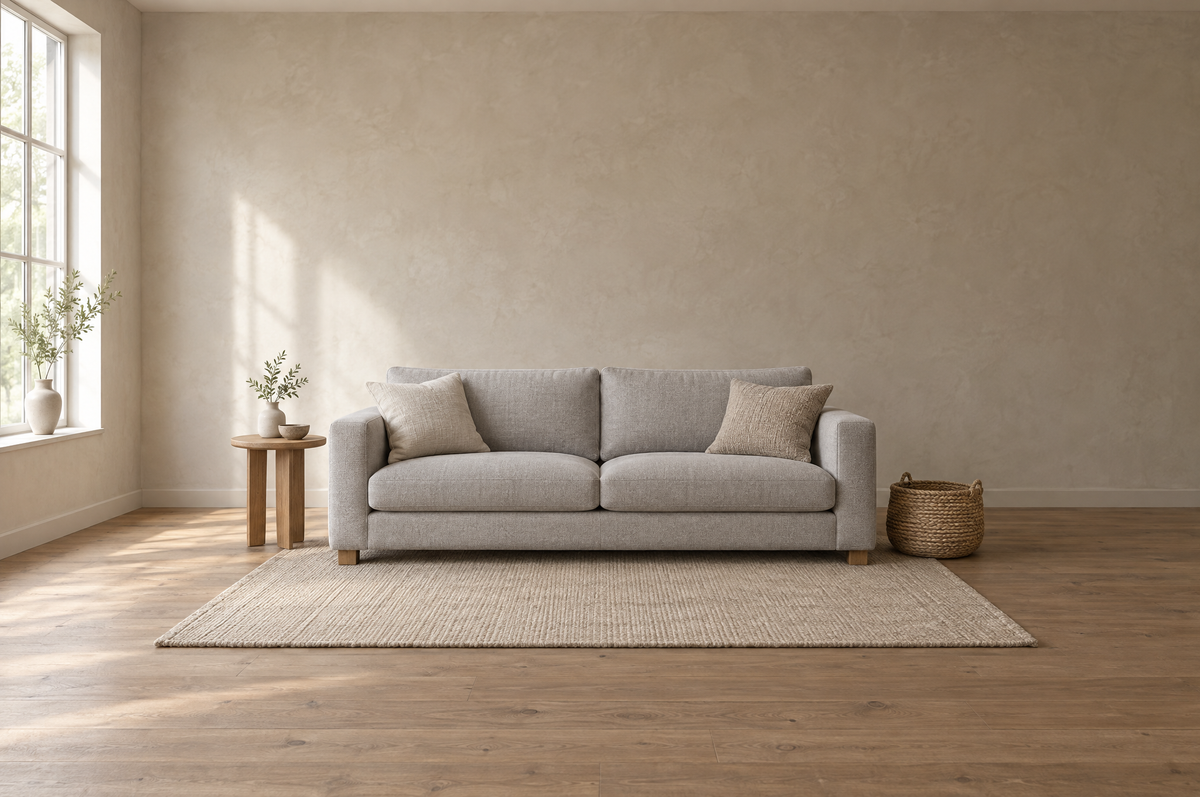
What Colors Go With a Grey Sofa? Undertones, Accents and Wall Colors
The safest answer is a warm neutral plus one accent: cream, oatmeal or camel across most of the room, natural wood in the furniture, and a single saturated color repeated two or three times in pillows, a chair or a lamp. Rust, mustard, olive, navy and dusty pink all read well against grey. Which of those actually works in your room depends on one thing most guides skip: whether your grey leans blue or leans brown. Cool greys want cool or high-contrast partners like navy, emerald and crisp white. Warm greys want earth tones like terracotta, camel and olive. Get the undertone right and almost any accent color behaves.
Start by working out whether your grey is warm or cool
Grey is never just grey. Every grey carries an undertone, and it is the undertone, not the greyness, that decides which colors sit comfortably next to it.
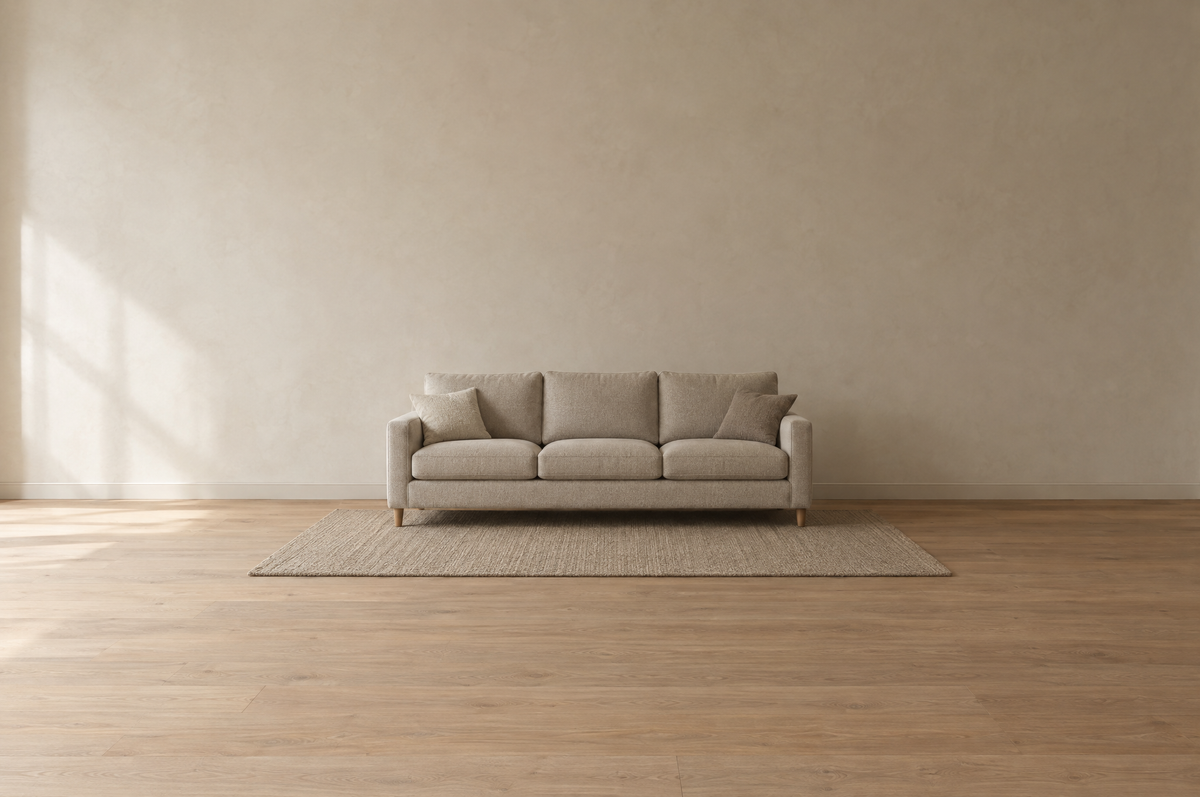
The quickest test costs nothing. Put a sheet of plain printer paper flat against the sofa in daylight, away from a lamp. Against true white, a cool grey will show a blue, violet or green cast. A warm grey will look faintly brown, taupe or putty. If it looks like nothing at all and just reads as clean grey, you have a neutral grey, which is the most forgiving of the three.
Do this at two times of day if you can. North-facing rooms push everything cooler, and a grey that looked warm in an afternoon west light can look distinctly blue at ten in the morning.
What pairs with each undertone
| Undertone | How to spot it | Accent colors that work | Colors to be careful with |
|---|---|---|---|
| Cool (blue or violet cast) | Looks slightly blue next to white paper | Navy, emerald, deep teal, crisp white, blush, charcoal | Orange-based terracotta, warm beige, honey oak |
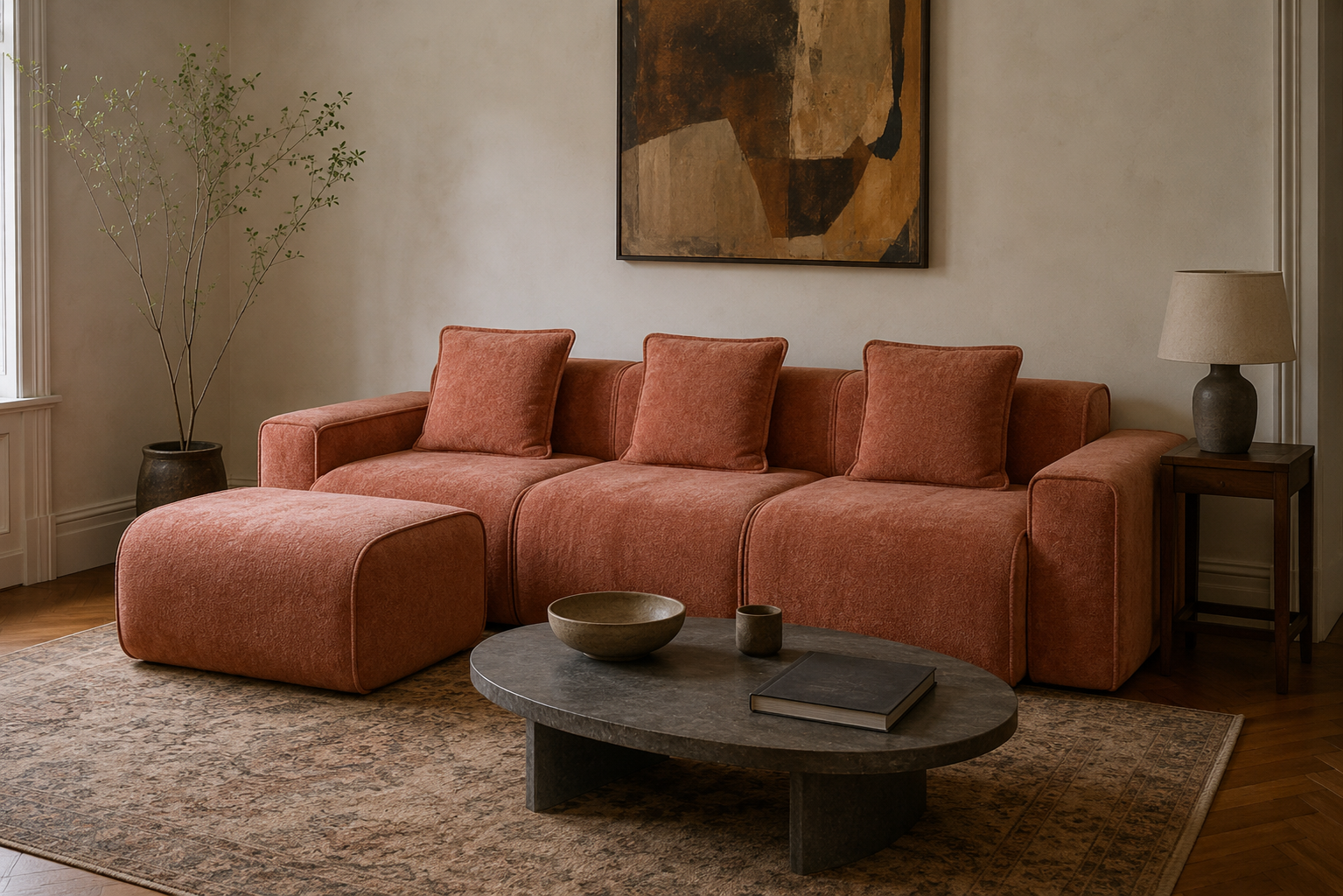
| Warm (brown or taupe cast) | Looks faintly brown or putty next to white paper | Camel, rust, olive, cream, caramel, warm brass | Icy blue, stark white, cool silver |
| Neutral (no clear cast) | Reads as plain grey against white paper | Almost anything, including mustard, sage, black and burgundy | Very little, though muddy mid-tones can fall flat |
How light or dark the grey is changes the answer
Depth matters as much as undertone. The catalogue sorts grey upholstery into three named ranges, and they behave differently in a room.
Light grey acts almost like a neutral wall. It reflects a lot of light, so it needs contrast somewhere or the room goes soft and shapeless. A dark rug, a black metal lamp or a walnut coffee table gives the eye somewhere to land. The Light Gray Sherpa L-Shaped Sleeper Sectional is a good example of the problem and the fix: at 115.2 inches wide by 83.8 inches deep it occupies a lot of visual space in pale fleece, so it wants something solid nearby rather than more pale neutrals.
Mid grey is the easiest to decorate around. It has enough weight to anchor the room on its own and enough restraint to take a bold accent without fighting it. A 3-seat piece like the Gray Chenille 3-Seat Curved Sofa, at 86 inches wide and 27.5 inches tall, sits low and quiet enough that a strong pillow color carries the whole scheme.
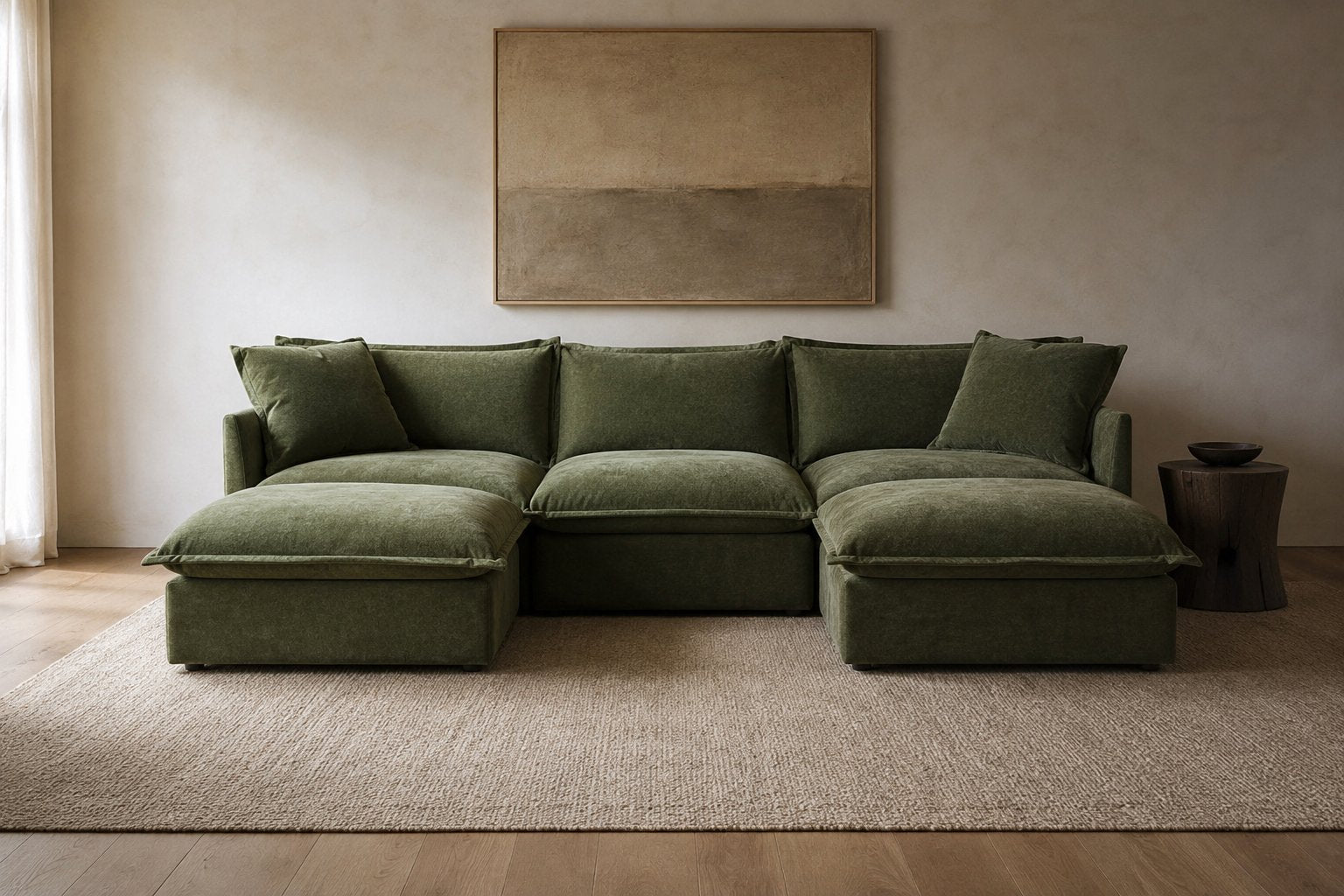
Dark grey behaves like a soft black. It will absorb light, so pale walls and a light floor keep the room from closing in. It also takes warm metals well. The Dark Gray Corduroy U-Shaped Sectional pairs its 128.4 inch span with 24.2 inch seat depth, which is deep enough that a lighter throw across one corner genuinely helps break up the mass.
If you are still choosing, the full range of shades sits in Gray Couches, and the L-shaped and U-shaped pieces are grouped separately under Gray Sectionals.
Texture changes the color as much as the dye does
Two sofas can share a color name and look like different colors on delivery day, because the weave decides how much light comes back at you.
- Chenille has a high-density pile that catches light at different angles. The same grey looks lighter where the pile lies one way and deeper where it lies the other, so it reads as a softer, more variable grey.
- Corduroy has ribs that throw tiny parallel shadows. This consistently darkens the apparent color by a shade, which is why a mid grey corduroy can look close to charcoal in a dim room.
- Velvet and flannelette are the most dramatic. They shift noticeably as you walk past, and a light grey velvet can look almost silver in direct light.
- Sherpa and fleece scatter light rather than reflecting it, so the grey stays flat and matte, and looks lighter overall than a smooth fabric of the same shade.
- Linen and microfiber sit closest to the flat color you see on screen, with the least shift between light and shade.
The practical consequence: if you are matching a grey sofa to paint or to an existing rug, match it to the fabric you are actually buying, not to a color name. Upholstery material is published in the specifications on each listing.
A proportion that keeps the room from going flat
The common design convention is the 60-30-10 split: roughly 60 percent of the room in a dominant neutral, 30 percent in a secondary tone, 10 percent in an accent. It is a rule of thumb rather than a law, but it is useful here because grey sofas fail in a predictable way. People buy the grey sofa, then add grey pillows, a grey rug and grey-painted walls, and end up with a room that has no focal point.
A workable split with a grey sofa looks like this:
- 60 percent: walls, floor and the sofa itself, in grey plus a warm neutral like cream or oatmeal.
- 30 percent: a secondary material with its own character, usually natural wood, plus a rug that is not grey.
- 10 percent: your one accent color, repeated in at least three places so it looks intentional.
That last point is the one that does the work. A single mustard pillow looks like an accident. The same mustard in two pillows, a throw and a lampshade looks like a decision.
Where to put the accent color
Accents are cheaper and easier to change than the sofa, so this is where to experiment.
Pillows are the obvious first move, and size matters more than people expect. Sofas in this category commonly ship with throw pillows around 16.5 inches square, so if you are buying replacements, matching that footprint keeps the proportions right against the backrest. Buy covers rather than whole pillows if you plan to change color seasonally.
An accent chair carries more color than any pillow can, and it is the single most effective way to break up a grey seating group. Something in olive, rust or a warm boucle placed at an angle to the sofa does more than a dozen small objects. The range sits in Accent Chairs.
An ottoman in a contrasting fabric works well with the deeper sectionals, where the seat depth already invites putting your feet up. See Ottomans.
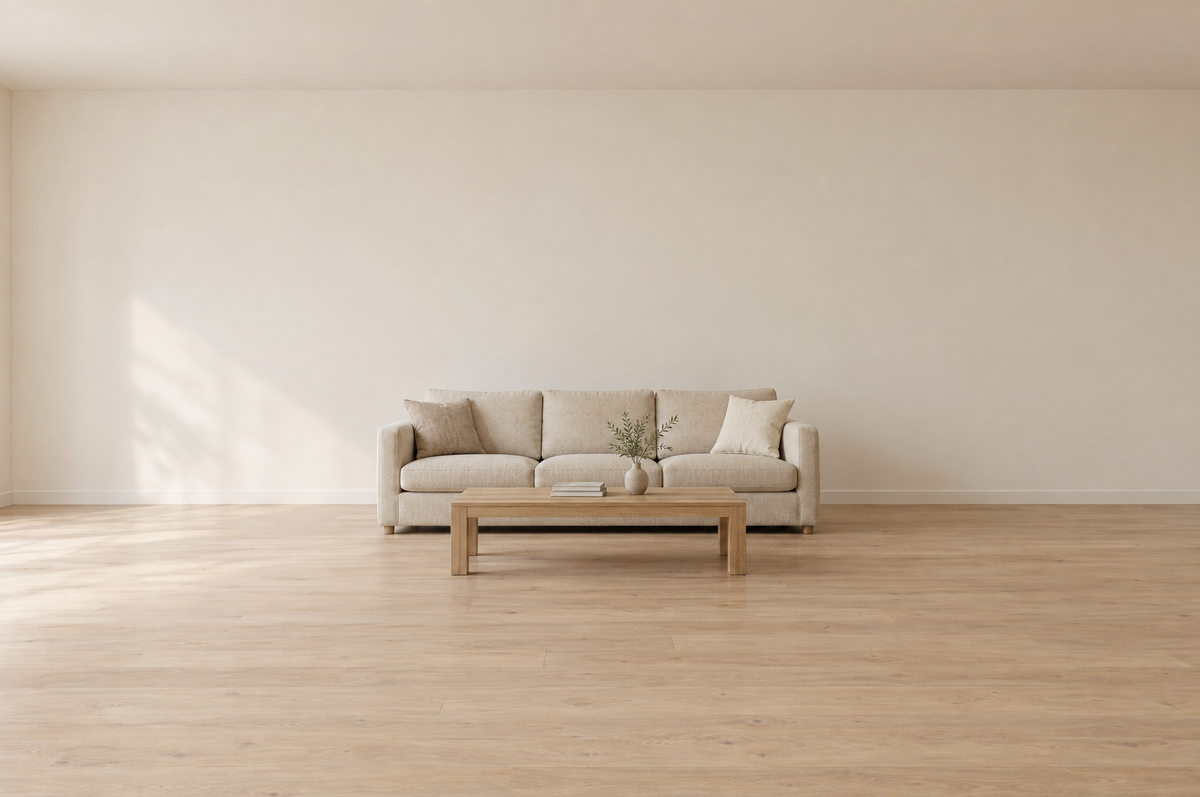
Wood tone is the accent most people forget is an accent. A walnut or oak coffee table introduces warmth that no amount of textile can replicate, and against a cool grey it provides the temperature contrast the scheme is usually missing.
Wall colors that work behind grey
Grey sofas are usually bought before the walls are repainted, so this comes up constantly.
Warm white and soft cream are the reliable defaults. They give a grey sofa something to sit against without competing, and they work with either undertone. Greige, a beige with grey in it, works particularly well behind a warm grey sofa because it continues the undertone rather than contradicting it.
Painting the walls the same grey as the sofa is the common mistake. The sofa disappears into the wall, and because the paint and the fabric will never be an exact match, the small difference between them reads as an error rather than a choice. If you want a grey wall, go at least two shades lighter or darker than the sofa so the difference is clearly deliberate.
Deep colors work if the room has the light for them. Navy behind a light grey sofa, or a deep olive behind a mid grey, both hold up well. Dark walls behind a dark grey sofa need real daylight to avoid feeling heavy.
Frequently asked questions
Does a grey sofa go with beige walls?
Yes, and it is one of the more forgiving combinations, but it depends on the undertone. A warm grey sofa sits naturally against beige because both lean brown. A cool grey against a yellow-heavy beige can look slightly off, since one is pulling blue and the other is pulling yellow. If your grey is cool, choose a beige with a grey cast, often sold as greige, rather than a warm sandy beige.
What color rug goes with a grey couch?
A rug that is not grey. The most common error is a grey rug under a grey sofa, which flattens the whole floor area. Cream, oatmeal and natural jute all work with any grey. If you want pattern, a rug that contains your accent color plus the grey ties the scheme together and does the job of repeating the accent for you. For dark grey sofas, a lighter rug is usually better, because it stops the seating area from reading as one heavy block.
Should throw pillows match the grey sofa or contrast with it?
Contrast, in at least some of them. Matching pillows on a matching sofa remove all definition from the seat. A practical mix is two pillows in a contrasting accent color, one in a textured neutral like cream boucle or linen, and one pattern that contains both. Sofas in this category commonly ship with throw pillows around 16.5 inches square, which is a useful size to match when buying extras.
Do warm wood tones work with a grey sofa?
They do, and they are usually an improvement. Grey is a cool-leaning neutral even in its warm versions, and oak, walnut and teak add the warmth that stops a grey room feeling cold. Walnut works with almost any grey. Very orange-toned woods like honey pine can clash with a strongly blue-grey sofa, so with a cool grey lean toward darker or greyer woods.
Is a dark grey sofa harder to decorate around than a light grey one?
It is not harder, but it demands more contrast elsewhere. A dark grey sofa absorbs light, so it needs pale walls, a lighter floor or a light rug to keep the room balanced. In exchange it hides marks better and anchors a room more confidently than a light grey. Light grey is more flexible with color but shows wear sooner and needs a dark element somewhere to stop the room looking washed out.
What if the grey looks different in person than it did on screen?
This happens, and it is worth planning for. Screen calibration, room lighting and fabric texture all shift how a grey reads, and suppliers note that colors may vary slightly from product images for exactly this reason. Order swatches where they are offered, and view the sofa's photos on more than one device before committing. If it does arrive wrong, Two Seventy Nine accepts returns within 30 days. Shipping to you is free, and return shipping is paid by the customer, so it is worth getting the shade right before ordering rather than after.
Method and sources
Search volume and keyword difficulty figures referenced in planning this article come from Semrush, US database, harvested September 2026. Those figures are third-party estimates based on modelled clickstream data, not measured traffic, and they move month to month. All product dimensions, upholstery materials, fabric compositions and cushion specifications quoted here are taken from Two Seventy Nine product records and the supplier specifications published on each listing. Dimensions are manually measured by suppliers and may vary slightly. The 60-30-10 proportion is a widely used interior design convention rather than a measured standard, and is offered here as a starting point, not a rule.